

For decades, formalin has been the gold standard for tissue fixation in pathology laboratories worldwide. Its effectiveness in preserving tissue morphology has made it an indispensable component of diagnostic workflows.
However, growing scientific evidence continues to highlight another important aspect of formalin use: **occupational exposure to formaldehyde** and its implications for laboratory professionals.
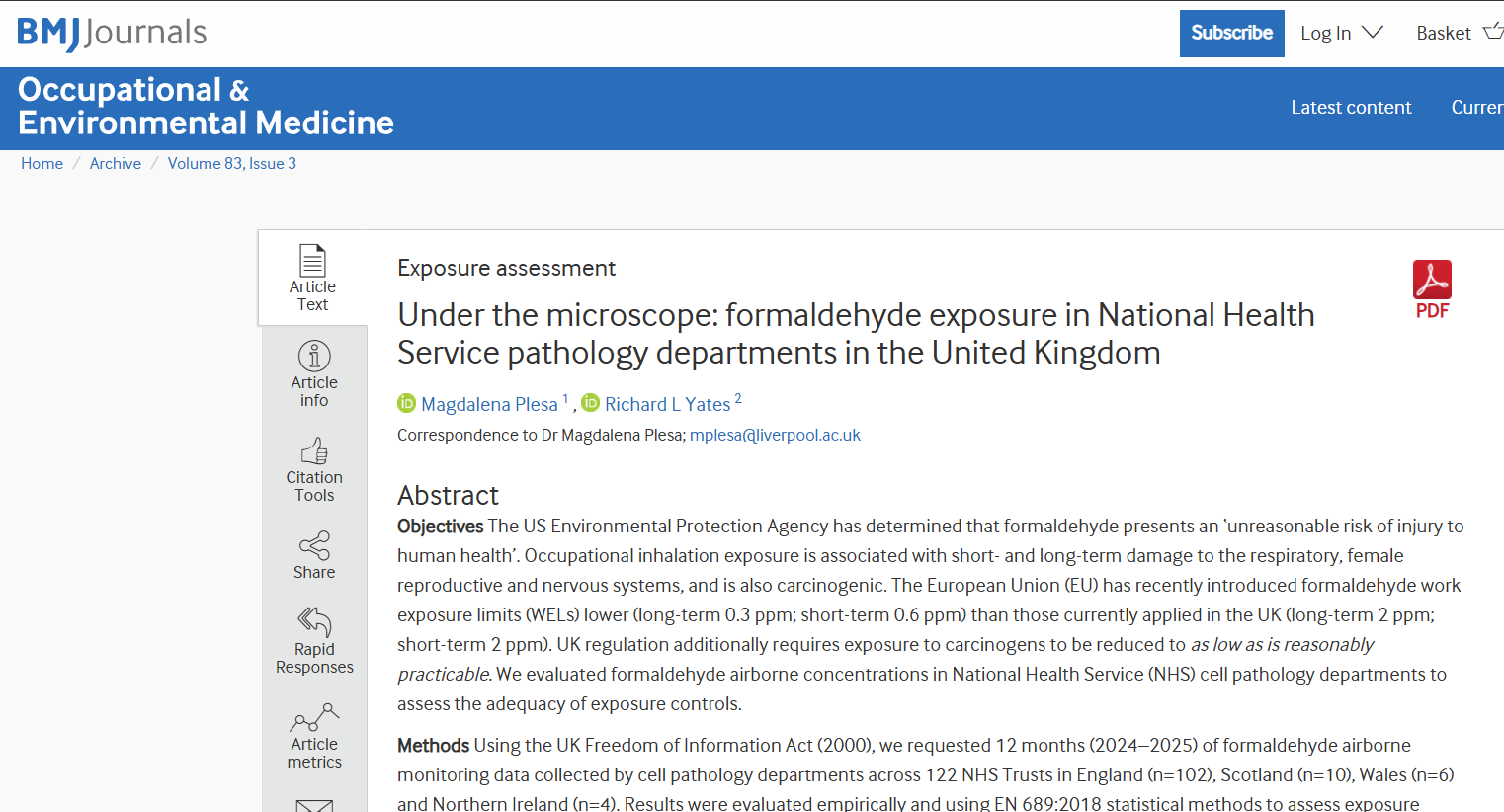
A recently published study in Occupational & Environmental Medicine (BMJ), now indexed in PubMed, provides one of the most comprehensive analyses to date of airborne formaldehyde exposure within pathology departments of the UK National Health Service (NHS).
A nationwide assessment of pathology laboratories
Researchers analyzed more than 1.7 million airborne formaldehyde measurements collected from 117 NHS cellular pathology laboratories during 2024-2025.
The objective was to evaluate how effectively occupational exposure is monitored and controlled in routine pathology practice.
The results raise important questions.
According to the study:
73% of laboratories monitored airborne formaldehyde concentrations only once per week or less;
70% of laboratories regularly exceeded the European Union long-term occupational exposure limit of 0.3 ppm;
43% exceeded the EU short-term exposure limit of 0.6 ppm;
the authors concluded that exposure monitoring and exposure control remain inadequate in many pathology departments.
The study also calls for stronger occupational safety measures, including more frequent monitoring, improved laboratory infrastructure, enhanced staff training, and better implementation of exposure control strategies.
Beyond compliance: protecting pathology professionals
Pathology laboratories exist to deliver accurate diagnoses, but they are also workplaces where healthcare professionals spend many hours every day handling biological specimens and chemical reagents.
As pathology increasingly incorporates molecular diagnostics, digital pathology, and precision medicine, attention is expanding beyond diagnostic performance alone.
Today, laboratory quality is also measured by the ability to provide a safe working environment for pathologists, biomedical scientists, technicians, and laboratory personnel.
Reducing unnecessary occupational exposure to hazardous substances has therefore become an increasingly important objective for healthcare systems worldwide.
Innovation in tissue fixation
Improving occupational safety does not mean compromising diagnostic quality.
Instead, it requires innovation capable of addressing both objectives simultaneously.
At Addax Biosciences, this principle has guided the development of GAF® (Glyoxal Acid-Free Fixative).
Rather than focusing exclusively on replacing formalin, GAF was designed to support the evolving needs of modern pathology by combining three key goals:
– excellent preservation of tissue morphology;
– improved preservation of DNA, RNA and proteins to support molecular pathology and Next-Generation Sequencing (NGS) applications;
– elimination of formaldehyde from the fixation process, contributing to reduced occupational exposure during specimen fixation.
As molecular diagnostics continue to play an increasingly central role in patient care, tissue fixation is no longer simply a pre-analytical step.
It is becoming a strategic component of diagnostic quality, laboratory efficiency, and workplace safety.
The findings of the UK study reinforce an important message for pathology laboratories across Europe and beyond. Future innovation should not be limited to improving diagnostic accuracy alone. It should also support safer laboratory environments through technologies that combine high-quality tissue preservation with reduced occupational exposure to hazardous chemicals.
The evolution of pathology depends not only on better diagnostics, but also on better conditions for the professionals who make those diagnoses possible every day.