

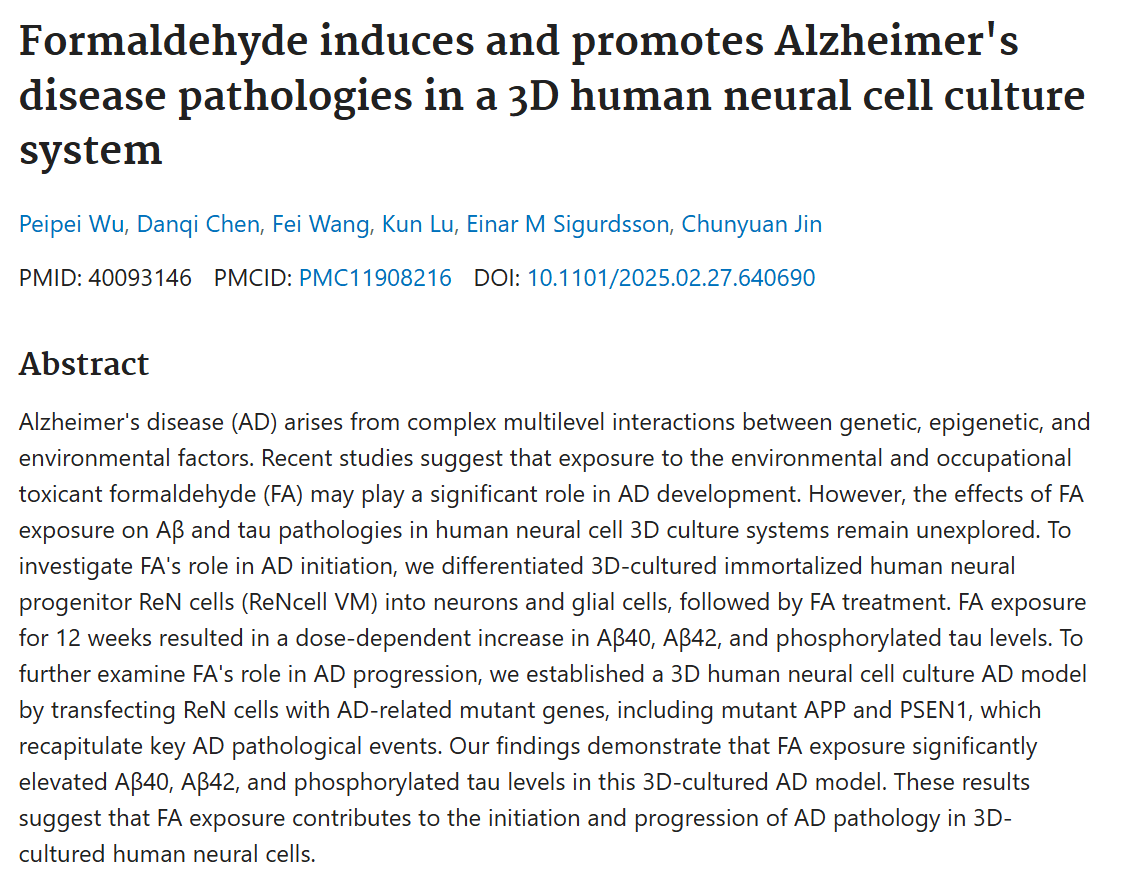
A recent study published on bioRxiv in March 2025 by a team of researchers led by Peipei Wu, Danqi Chen, Fei Wang, Kun Lu, Einar M Sigurdsson, and Chunyuan Jin has shed new light on the potential dangers of formaldehyde exposure, particularly in relation to Alzheimer’s disease. This research utilized an advanced 3D human neural cell model, a cutting-edge tool that closely replicates the complexity of brain tissue, allowing scientists to observe how formaldehyde interacts with neural structures.
The study revealed that exposure to formaldehyde not only triggers but actively promotes pathological features commonly associated with Alzheimer’s disease. In particular, the researchers noted a significant increase in the presence of:
- Aβ40 and Aβ42, two proteins linked to the formation of amyloid plaques, a hallmark feature in Alzheimer’s patients.
- Phosphorylated tau, a key marker of neurodegeneration that is heavily implicated in the progression of the disease.
These findings reinforce growing concerns about the link between prolonged formaldehyde exposure and the onset of neurodegenerative conditions, suggesting that this widely used chemical could contribute to the development of Alzheimer’s.
Formaldehyde is a well-known fixative commonly employed in medical laboratories for tissue preservation. Despite its widespread use, several studies highlight the urgent need to reconsider its application due to its established toxicity and newly identified role in promoting neurodegenerative pathologies.
Given the study’s compelling evidence, researchers stress the importance of adopting safer, innovative alternatives to formaldehyde. Such solutions should ideally offer the same efficacy in preserving biological samples while minimizing the risks to both laboratory personnel and patient outcomes.
This study marks a significant step forward in understanding the environmental and chemical factors contributing to Alzheimer’s disease. It highlights the need for increased awareness in scientific practices and emphasizes the urgency of transitioning to safer methodologies in medical and research environments.